
Preview
Creation Date
2-1-2004
Description
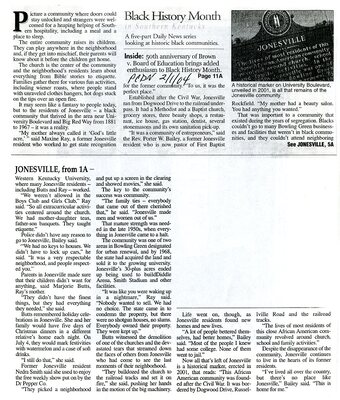
Picture a community where doors could stay unlocked and strangers were welcomed fro a heaping helping of Southern hospitality, including a meal and a place to sleep.
The entire community raises its children. They can play anywhere in the neighborhood and, if they get into mischief, their parents will know about it before the children get home.
The church is the center of the community and the neighborhood's residents learn about everything from Bible stories to etiquette. Families gather there for various fun activities, including wiener roasts, where people stand with unraveled clothes hangers, hot dogs stuck on the tips over the fire.
It may seem like a fantasy to people today, but to the residents of Jonesville - a black community that thrived in the area near University Boulevard and Big Red Way from 1881 to 1967 - it was a reality.
"My mother always called it 'God's little acre,'" said Maxine Ray, a former Jonesville resident who worled to get state recognition for the former community. "To us, it was the perfect place."
Established after the Civil War, Jonesville ran from Dogwood Drive to the railroad underpass. It had a Methodist and a Baptist church, grocery stores, three beauty shops, a restaurant, ice house, gas station, dentist, several stonemasons and its own sanitation picku-up.
"It was a community of entrepreneurs," said the Rev. Porter W. Bailey, a former Jonesville resident who is now a pastor of First Baptist Rockfield. "My mother had a beauty salon. You had anything you wanted."
That was important to a community that existed during the years of segregation. Blacks couldn't go to many Bowling Green businesses and facilities that weren't in black communities, and they couldn't attend neighboring Western Kentucky University, where many Jonesville residents - including Butts and Ray - worked.
"We weren't allowed in the Boys Club and Girls Club," Ray said. "So all extracurricular activities centered around the church. We had mother-daughter teas, father-son banquets. They taught etiquette."
Police didn't have any reason to go to Jonesville, Bailey said.
"We had no keys to houses. We didn't have to lock up cars," he said. It was a very respectable neighborhood, and people respected you."
Parents in Jonesville made sure that their children didn't want for anything, said Marjorie Butts, Ray's mother.
"They didn't have the finest things, but they had everything they needed," she said.
Butts remmebered holiday celebrations in Jonesville. She and her family would have five days of Christmas dinners in a different relative's home each night. On July 4, they would mark festivities with watermelon and a case of soft drinks.
"I still do that," she said.
Former Jonesville resident Nedra Smith said she used to enjoy the free weekly show put on by the Dr. Pepper Co.
"They picked a neighborhood and put up a screen in the clearing and showed movies," she said.
The key to the community's success was community.
"The family ties - everybody that came out of there cherished that," he said. "Jonesville made men and women out of us."
That mature strength was neededin the late 1950s, when everything in Jonesville came to a halt.
The community was one of two areas in Bowling Green designated for urban renewal, and by 1968, the state had acquired the land and sold it to the growing university. Jonesville's 30-plus acres ended up being used to build Diddle Arena, Smith Stadium and other facilities.
"It was like you were waking up in a nightmare," Ray said. "Nobody wanted to sell. We had no choice. The state came in to condemn the property, but there were no shotgun houses, no slums. Everybody owned their property. They were kept up."
Butts witnessed the demolition of one of the churches and hte devastated tears that streamed down the faces of others from Jonesville who had come to see the last moments of their neighborhood.
"They bulldozed the church to the railroad tracks and set it on fire," she said, pushing her hands in the motion of he big machinery.
Life went on, though as Jonesville residents found new homes and new lives.
"A lot of people bettered themselves, had better homes," Bailey said. "Most of the people I knew had some college. None of them went to jail."
Now all that's left of Jonesville is a historical marker, erected in 2001, that reads: "This African American community was founded after the Civil War. It was bordered by Dogwood Drive, Russellville Road and the railroad tracks.
"The lives of most residents of this close African American community revolved around church, school and family activities."
Despite the disappearance of the community, Jonesville continues to live in the hearts of its former residents.
"I've lived all over the country, but there's no place like Jonesville," Bailey said. "This is home for me."
Keywords
Western Kentucky University, Jonesville